
Pay stub guide
How to Read a Pay Stub
A pay stub (also called a paystub, paycheck stub, check stub or earnings statement) looks busy, but it follows the same order every time: who was paid, for what period, how much was earned, what was taken out and what was left. This guide walks through each section so you can read any pay stub with confidence.
The six parts of a pay stub
1. Employer and employee information
The top of a pay stub says who paid whom. You'll see the employer's name and address, often an employer ID number, and your name, address and employee ID. Only the last four digits of a Social Security number should ever be printed.
Check that your name is spelled correctly and the address is current. A wrong name or number on a pay stub can cause trouble later when a landlord or lender compares it with other documents.
2. Pay period, pay date and pay frequency
The pay period is the range of days the pay covers, such as the 12th to the 25th. The pay date is the day the money was issued, and it usually falls a few days after the period ends. The pay frequency (weekly, every two weeks, twice a month or monthly) tells you how many paychecks you get in a year.
3. Earnings and gross pay
Earnings lists every way you were paid in this period: regular hours, overtime, bonuses, commissions, tips, vacation or holiday pay. Each line shows hours, rate and amount, and together they add up to gross pay, your total earnings before anything is taken out.
If you're hourly, multiply hours by rate yourself. If the total on the stub doesn't match your own math, ask your payroll contact to explain the difference.
4. Deductions and withholdings
This section shows everything subtracted from gross pay. It usually has two groups. Taxes are required by law: federal income tax, Social Security, Medicare and, where your state has one, state income tax. Deductions are the other amounts taken out, such as retirement contributions, health insurance premiums, union dues or wage garnishments.
5. Net pay
Net pay is gross pay minus all taxes and deductions. It's the amount that actually reaches your bank account or check, which is why it's often called take-home pay.
6. Year-to-date (YTD) totals
Most stubs add a second column that totals each line from January 1 through the current pay date: gross pay, each tax, each deduction and net pay. YTD figures let you see your full earnings so far this year and are what a lender or tax preparer checks first.
A worked example
Here is a sample stub with made-up details: an employee paid every two weeks in Georgia, working 80 regular hours at $24.50 and 6 overtime hours at $36.75.
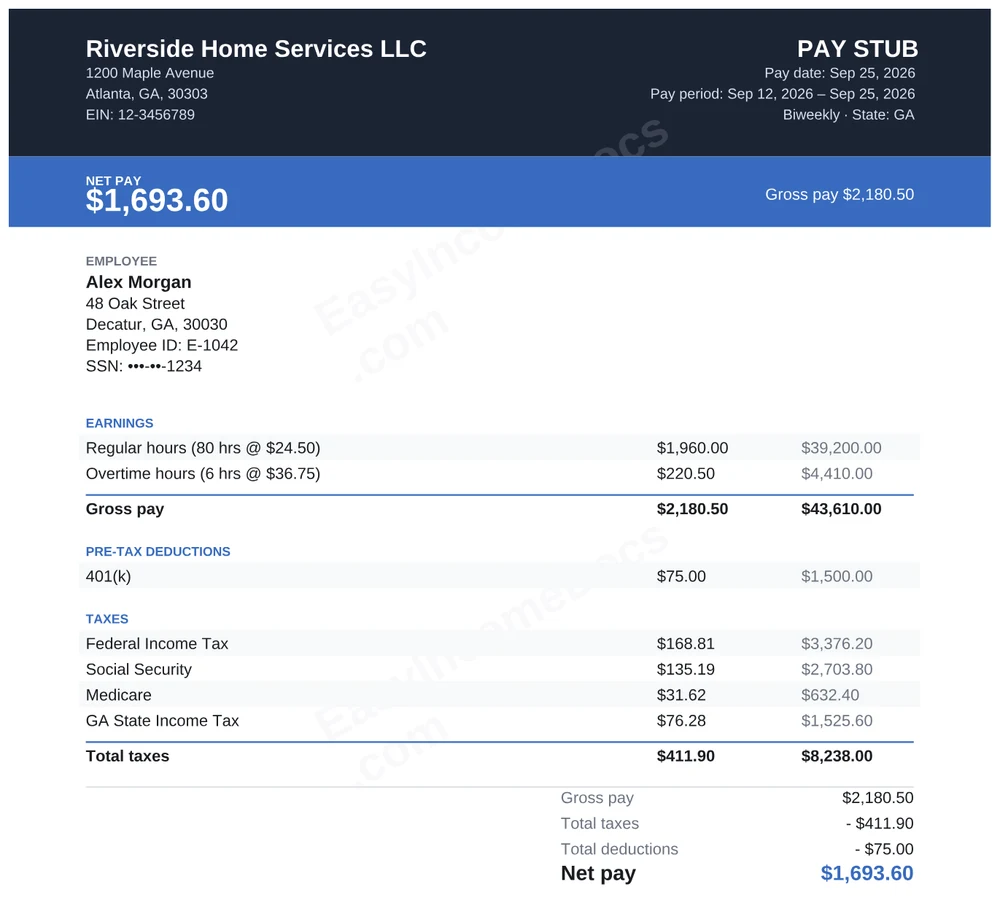
- Regular pay: 80 hours x $24.50 = $1,960.00. Overtime: 6 hours x $36.75 = $220.50. Gross pay is $2,180.50.
- Social Security is 6.2% of $2,180.50, which is $135.19, and Medicare is 1.45%, which is $31.62.
- The $75.00 401(k) contribution lowers the wages used for income tax, but Social Security and Medicare are still figured on the full $2,180.50.
- Federal income tax ($168.81) and Georgia state income tax ($76.28) bring total taxes to $411.90.
- Net pay: $2,180.50 minus $411.90 in taxes minus $75.00 in deductions is $1,693.60.
What each tax line means
- Federal income tax
- Withheld using the IRS withholding tables, based on your pay, filing status and the answers on your W-4. The amount can be higher or lower from person to person at the same pay.
- Social Security
- 6.2% of your wages, up to a yearly wage limit. Your employer pays a matching 6.2% on top, which doesn't appear on your stub.
- Medicare
- 1.45% of all your wages with no limit. Higher earners pay an additional 0.9% above an IRS threshold.
- State income tax
- Depends on where you work. Nine states do not tax wages: Alaska, Florida, Nevada, New Hampshire, South Dakota, Tennessee, Texas, Washington and Wyoming. The other states use their own rates and rules.
- Other state or local items
- Some places add items such as state disability insurance, paid family leave or city and county income tax. They appear as their own lines.
Pre-tax and post-tax deductions
Deductions come in two kinds. Pre-tax deductions such as traditional 401(k) contributions and many health insurance premiums come out before income tax is figured, so they reduce your taxable income. Post-tax deductions such as Roth contributions or wage garnishments come out after taxes and don't change your tax bill. The label next to each line on your stub usually tells you which kind it is.
Checklist: is your pay stub right?
- Your name, employer name and pay period are correct.
- Hours multiplied by your rate matches the earnings lines, with overtime at the right rate.
- Social Security is about 6.2% of gross pay and Medicare about 1.45%, unless you're above the limits.
- Pre-tax deductions such as 401(k) lower your income tax wages but not your Social Security and Medicare wages.
- Gross pay minus every tax and deduction equals net pay.
- Year-to-date totals are larger than this period's amounts and keep growing from stub to stub.
- The amount that hit your bank account matches net pay.
Why pay stubs matter
A pay stub is your record of what you earned and what was withheld. You can use it to check that you were paid correctly, to confirm your taxes were taken out, to plan a budget, and to show income when you apply for an apartment or a loan. If you don't get stubs from an employer, or you pay yourself as a business owner, you can build a stub with our pay stub generator, with the taxes calculated for your state.
Questions about reading a pay stub
How do I read a pay stub?
Start at the top with the employer, employee, pay period and pay date. Then read down through earnings (which add up to gross pay), taxes and deductions, and finally net pay. Compare the year-to-date column to see your totals for the year so far.
What is the difference between gross pay and net pay?
Gross pay is everything you earned before anything is taken out. Net pay is what is left after taxes and deductions, and it's the amount you actually receive.
Why is my net pay lower than what I expected?
Taxes and deductions come out of gross pay. Federal and state income tax, Social Security, Medicare and any benefits like health insurance or a 401(k) all reduce what you take home. Compare each line to the one on your last stub to find what changed.
What does YTD mean on a pay stub?
YTD stands for year to date. It is the running total of a pay stub line, such as gross pay or federal tax, from January 1 through the current pay date.
What are pre-tax deductions?
Pre-tax deductions, such as contributions to a 401(k) or some health insurance premiums, are subtracted before income tax is figured. That lowers the wages your income tax is based on, so you pay less income tax in that period.
What should I do if my pay stub looks wrong?
Compare the numbers against your hours, pay rate and last stub. If something doesn't add up, write down the line and the difference and ask your payroll or HR contact to review it. Keep copies of your stubs while the question is open.
Related guides and tools
- Pay stub examples and samples
- Pay stub requirements, abbreviations and record keeping
- Free pay stub template: printable hourly and salaried PDFs
- Hourly vs salaried pay stub: what is different
- What is a pay stub? A complete guide
- Pay stub template: what to include
- Free paycheck calculator
- How to make a pay stub, step by step
For your own accurate records. A pay stub must reflect real information and is not for misrepresenting income, employment or financial details to a lender, landlord, government agency or any other party.