
What Is a Voided Check? How to Void a Check (2026)
A voided check is a check marked VOID, used to set up direct deposit. Learn how to void a check, when you need one, and what to do if you don't have a checkbook.
Make your voided check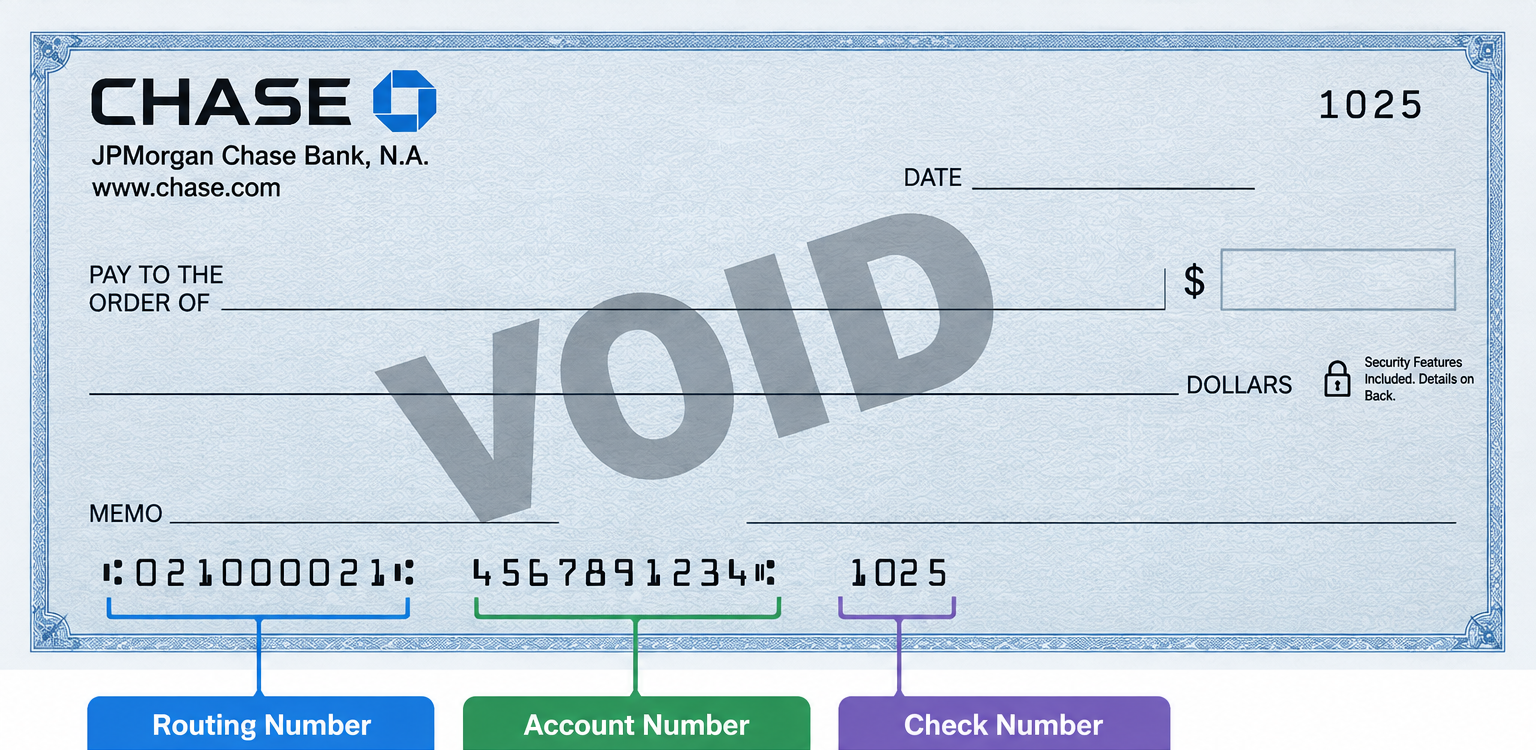
What is a voided check?
A voided check is one you've intentionally marked "VOID" to show it should never be used for payment. It still displays your name and address, your bank's name, the routing number, your account number and the check number — the exact details an employer, company or financial institution needs to set up an electronic transaction, such as sending a paycheck to the right account.
The check has no payment value once it's voided, but the printed banking details on it are still sensitive. Only hand it to a legitimate person or organization that actually needs it.
When do you need a voided check?
Direct deposit is the most common reason — when you start a new job, payroll may ask for a voided check to set up electronic deposits, though some employers use a direct-deposit form where you type in the details yourself instead. A company that will withdraw a recurring automatic payment, such as a monthly bill, may also ask for one, though many now use online ACH authorization forms in its place.
It's the standard way to share what ACH (Automated Clearing House) transfers need — the routing number, account number and bank name, all in one place — for bank-to-bank payments, and a business paying an independent contractor or vendor may request one to set up future electronic payments. Requirements vary by organization, so always confirm what documentation they actually need before sending anything.
How to void a check
Start with an unused check from your checking account that hasn't been filled out or signed — never hand over a blank, signed check, since anyone holding it could complete it and withdraw money from your account. Using dark blue or black ink, write "VOID" in large letters across the front so the marking stays clearly visible even if the check is scanned or photographed, while keeping the routing number, account number and check number readable; you can also mark through the payee, amount and signature areas so the check can't be altered.
Don't sign it — there's no reason to sign a check you're voiding. If you're giving the original away, note the check number and the reason it was voided in your checkbook; if you're keeping it instead, store it securely or destroy it properly rather than leaving it loose.
What if you don't have paper checks?
Not having a checkbook doesn't stop you from setting up direct deposit or electronic payments. Ask the requester what they accept — alternatives can include a direct-deposit authorization form, a bank-generated account verification document, a bank statement, your routing and account numbers entered directly on an online form, or occasionally a deposit slip.
You can also get the details from your bank: most show your routing number, account number and account type in online banking or on a statement, and many banks can issue a bank-generated voided check or a direct-deposit verification letter on request — what's available depends on your bank, so ask. An online voided check generator that formats your real routing and account numbers into the standard layout is another option many people use when their bank doesn't offer this directly. Don't assume every employer or company accepts the same alternative — confirm before sending any banking information.
Voided check vs. canceled check
The terms sound alike but mean different things. A voided check is an unused check you've marked as unusable, typically to share banking information. A canceled check is one that has already been processed and paid by the bank. If someone asks you for a voided check, they want an unused check marked "VOID" — not one that has already cleared.
How to protect yourself
A voided check still exposes your routing and account numbers, so a few precautions are worth taking: provide it only when necessary, and ask what it will be used for and whether another form of verification would work instead. Never give out a blank signed check — treat checks like cash. Make the "VOID" marking obvious so it can't be easily removed or overlooked, and verify who you're actually sending it to before emailing, uploading or handing it over. Once a voided check is no longer needed, shred it rather than tossing it in the trash, since it still contains your account information.
Free voided check example and related guides
See a labeled sample with the routing, account and check numbers in our voided check for direct deposit guide, which includes a free printable example and a direct deposit information sheet. If you have no checkbook, read how to get a voided check without a checkbook. More free downloads are on the free resources page.
Frequently asked questions
Why does my employer want a voided check?
Usually to get the banking information needed to set up direct deposit — payroll departments are familiar with the format and can read the routing and account numbers directly from it.
Do I need a voided check for direct deposit?
Often, yes — many employers ask for one specifically to set up direct deposit, since it's a quick, familiar way to hand over the routing and account number your paycheck needs to go to. Some accept a direct deposit form or your account details typed into a portal instead, so it's worth asking what your specific employer requires before assuming.
Why would I need a voided check?
Most commonly to set up direct deposit for a paycheck, but also to authorize a recurring automatic bill payment, set up an ACH bank-to-bank transfer, or let a business pay a contractor or vendor electronically. See the "When do you need a voided check?" section above for the full list.
Do I have to sign it?
No. You generally shouldn't sign a check you're voiding.
Can I use a voided check to make a payment?
No. Once properly voided, it shouldn't be used as a payment.
Can someone cash a voided check?
It isn't meant to be used as a payment, but your account and routing numbers are still visible on it, so only share it with organizations you trust.
Can I void an old check?
If it was never used, yes. A check that has already been processed or paid isn't the same as a voided check.
What if I accidentally wrote VOID on a check?
Treat it as void and use a different check for any payment.
Can I get a voided check from my bank?
Possibly — if you don't have paper checks, ask your bank whether it can provide a bank-generated voided check or another document showing your account and routing information.
Is a voided check the same as a blank check?
No — a blank check is unused and still negotiable. A voided check has "VOID" marked on it specifically so it can never be cashed or altered.
Where are the routing and account numbers on a check?
Along the bottom edge, printed in special magnetic ink. The routing number is the 9-digit number, usually at the bottom left, followed by your account number and then the check number — though the order can vary slightly by bank, so check the labels or your bank's website if you're unsure.
Is it safe to give someone a voided check?
It's generally considered low risk because the VOID marking stops it being used as a payment, and the numbers on it are mainly used to deposit money into your account. Still, it shows your routing and account numbers, so only give one to an employer or company you trust and have confirmed is the real requester.
Do I need a voided check if I only bank online?
Not necessarily. Many employers accept a direct deposit form where you type your routing and account numbers, and some banks provide a downloadable account verification letter. Ask the requester what they accept before you go looking for a paper check.
What's the difference between a voided check and a direct deposit form?
A voided check is a physical or printed check that carries your banking details; a direct deposit form is an authorization you fill out by hand or online with the same details. Employers usually accept either, and some prefer one over the other.